A Minor Key Guitar Chords: Shapes and Progressions
Learn the a minor key guitar chords: Am, Bdim, C, Dm, Em, F, G. Open and barre shapes, common progressions, and tips for beginners.
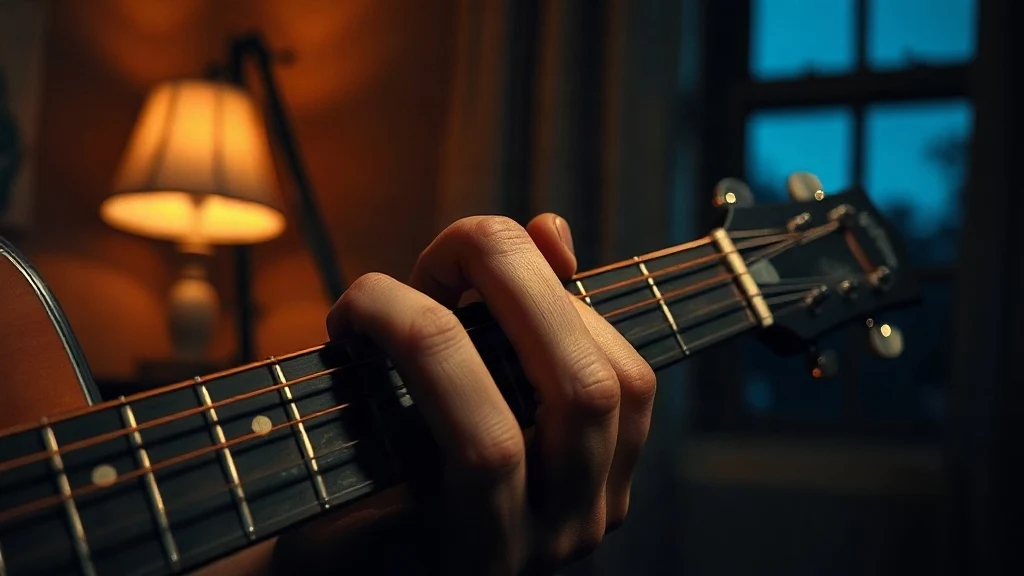
Updated 2026
Related reading: Discover our full guide on Ab Key Chords: Complete Guide with Shapes and Progressions.
Related reading: Discover our full guide on Flamenco Guitar Lessons: Chords, Compás, and Techniques.
Related reading: Discover our full guide on Bossa Nova Guitar Lessons: Chords, Rhythm, and Easy Songs.
The a minor key guitar chords are the seven chords built from the A natural minor scale: Am, Bdim, C, Dm, Em, F, and G. These chords form the backbone of countless songs in rock, pop, and folk music. In this guide, you will learn each chord shape, how to play them as open or barre chords, and the most common progressions used by guitarists.
What Are the A Minor Key Guitar Chords?
The a minor key guitar chords come from the A natural minor scale, which has the notes A, B, C, D, E, F, and G. When you stack thirds on each scale degree, you get seven chords. The chords are Am, Bdim, C, Dm, Em, F, and G. This is the same set of chords as the key of C major, because A minor is the relative minor of C major. That means you already know many of these shapes if you have played in C major.
| Chord | Notes | Typical Shape |
|---|---|---|
| Am | A, C, E | Open |
| Bdim | B, D, F | Barre |
| C | C, E, G | Open |
| Dm | D, F, A | Open |
| Em | E, G, B | Open |
| F | F, A, C | Barre |
| G | G, B, D | Open |
The A Natural Minor Scale and Its Chords
The A natural minor scale is the foundation of the a minor key guitar chords. The scale formula is whole, half, whole, whole, half, whole, whole. Starting on A, you get A, B, C, D, E, F, G. Each scale degree gets a chord quality: the first, fourth, and fifth are minor; the second, third, and sixth are major; the seventh is diminished. So you get Am, Bdim, C, Dm, Em, F, G. This pattern is the same for any natural minor key, so once you learn it in A minor, you can transpose it to other keys.
Open Chord Shapes for A Minor
Most of the a minor key guitar chords have easy open shapes. The Am chord uses the open A string, the second fret on the D and G strings, and the first fret on the B string. The C chord uses the open C string, the first fret on the B string, and the second fret on the D string. The Dm chord uses the open D string, the second fret on the G string, and the first fret on the B string. The Em chord uses the open E string, the second fret on the A and D strings, and the open G, B, and high E strings. The G chord uses the open G string, the second fret on the A string, and the third fret on the low E and high E strings. These open shapes are the first ones most beginners learn.
Barre Chord Shapes for A Minor
Two chords in the a minor key guitar chords need barre shapes: Bdim and F. The Bdim chord is a barre chord at the second fret, using the E minor shape. Place your index finger across all six strings at the second fret, then use your ring finger on the fourth fret of the D string and your pinky on the fourth fret of the G string. The F chord is a barre chord at the first fret, using the E major shape. Barre all six strings at the first fret, then place your middle finger on the second fret of the G string, your ring finger on the third fret of the A string, and your pinky on the third fret of the D string. These barre chords take practice, but they are essential for playing in A minor.
Common A Minor Progressions
Many songs use the a minor key guitar chords in simple progressions. The most famous is Am-G-F-E, which is the axis progression used in countless rock and pop songs. Another common one is Am-C-G-F, which is a variation of the I-V-vi-IV progression. You can also try Am-Dm-Em, which is a i-iv-v progression, or Am-F-C-G, which is a i-VI-III-VII progression. Practice these progressions with a metronome to build smooth chord changes.
How to Practice A Minor Chords
Start by playing each chord as a whole note, holding it for four beats. Then switch between two chords, like Am and C, using a slow tempo. Gradually increase the speed. Use a metronome to keep time. Focus on clean fretting and avoiding muted strings. Once you are comfortable with open shapes, add the barre chords. Practice the F chord by playing just the top four strings first, then add the full barre. Remember that the guitar is a small orchestra. It is polyphonic. Every string is a different color, a different voice. This quote from Andrés Segovia reminds us to listen to each string as you play.
Frequently Asked Questions
What are the chords in the key of A minor?
The chords in the key of A minor are Am, Bdim, C, Dm, Em, F, and G. These are the seven chords built from the A natural minor scale.
Is A minor the same as C major?
Yes, A minor is the relative minor of C major. They share the same notes and chords, but the tonal center is different. In A minor, the Am chord feels like home.
What is the easiest a minor key guitar chord?
The easiest chord is Am, because it only uses two fingers. Place your first finger on the first fret of the B string and your second finger on the second fret of the D string, and strum all six strings.
How do I play the F chord in A minor?
The F chord is a barre chord at the first fret. Barre all six strings with your index finger, then add your middle, ring, and pinky fingers to form the E major shape. It takes practice to get all strings ringing clearly.
For more chord guides, explore our Guitar Chords category. You can also check out the All Chords in Key of G guide, the Aadd9 Chord shapes, and the A# Minor Chords article for more variations. For music theory background, see A minor on Wikipedia and MusicTheory.net.
Next story
Ab Key Chords: Complete Guide with Shapes and Progressions
Learn all Ab key chords: the seven diatonic chords in A-flat major, common progressions, barre shapes, and capo tricks. Updated 2026.